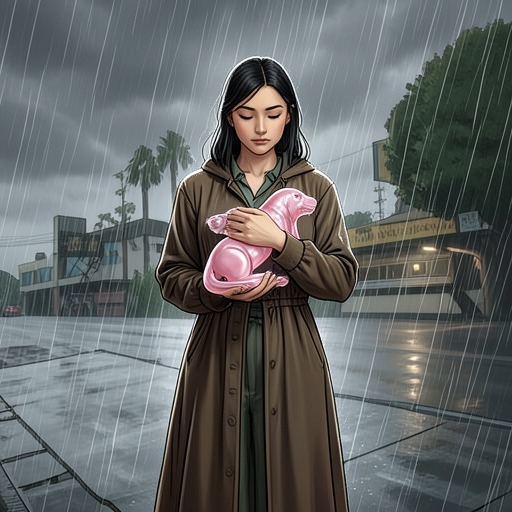
Weather-predicting glass sea lion
Elena KnowsThe Weather-predicting glass sea lion is a souvenir Rita buys on a holiday with her mother, Elena, and the sole object from Rita’s belongings that Elena preserves outside the box holding the rest. Its color is meant to forecast rain; after Rita’s death, Elena keeps it where she can see it every day, making the little ornament a material record of the weather on the afternoon her daughter died. It cannot explain how Rita came to be hanging from a church belfry, but it gives Elena one detail she refuses to let others dismiss.
Appearance and Weather Sign
The object sits in a shop window among seaside souvenirs. A sign identifies its color changes: blue for sunny weather, pink for rain. More precisely, the glass turns purplish pink as humidity approaches one hundred percent and precipitation becomes imminent. On the rainy afternoon when Rita dies, that is the color it shows. Its forecast is mundane and physical: a change in the air registers in the glass before the rain arrives. For Elena, the same change acquires a second meaning because it marks the day that divides her life with Rita from the life she has to continue without her.
The Weather-predicting glass sea lion is not merely an object Elena remembers from a trip. Its color provides a visible, repeatable sign that can be kept in the home, unlike the precise circumstances of Rita’s death, which remain unresolved. The glass does not tell Elena what happened at the church. Instead, its reliable relation to the weather fixes attention on one fact she considers important: it was raining.
Purchase in Mar del Plata
Rita first spots the Weather-predicting glass sea lion during one of the holidays she and Elena take at the coast. They travel to Mar del Plata every two years, renting a small two-room house near Colón Avenue. They do not go to the beach: the crowds and heat put them off, and neither wants the practical discomfort of carrying an umbrella or sitting on exposed sand. Instead, they sleep later, eat fresh-baked croissants and fish, and walk along the Rambla each afternoon as the sun begins to disappear behind the apartment buildings.
The purchase begins with Rita stopping at the souvenir-shop window and deciding that she will buy the ornament before they leave. Elena objects that Rita should not waste money on a trinket, given how hard it is for her to make ends meet. Rita insists on spending her money as she chooses, and the exchange turns into one of their familiar arguments. The dispute is not settled so much as absorbed into the pattern of their holidays: the two women walk, trade hurtful remarks, and eventually fall silent. They do not discuss the sea lion again during those walks, though Elena later jokes about a different souvenir in the shop—a corkscrew shaped like a priest—and Rita rebukes her for the joke.
Before the two-week holiday ends, Rita buys the Weather-predicting glass sea lion, as she had said she would. She pays in cash. Although she has a debit card, received when the school formally hired her and arranged direct deposits, she is afraid it might be stolen and does not carry it. She asks the shop to wrap the glass carefully; the sellers use bubble wrap, which Rita enjoys popping after she has carried the sea lion on her lap for the entire bus ride home. These details preserve the object’s ordinary history: it is wanted, purchased, protected from breaking, and handled with pleasure before it becomes bound to grief.
Elena’s Keeping and Placement
After Rita dies, Elena gathers her daughter’s possessions in a large cardboard box that once held a neighbor’s twenty-nine-inch television. She cannot put Rita’s clothes in with the other belongings. Their smell remains to her the smell of her living daughter, and she cannot bear to encounter that scent without seeing Rita. Nor can she give the clothes to the church and risk seeing Rita’s green sweater on someone else. She burns the clothes in the backyard instead. The Weather-predicting glass sea lion is the exception: it survives the separation between what Elena destroys and what she cannot give up.
Elena places it on a shelf in the dining room, between the radio and the telephone, but sets it a few centimeters forward. That small adjustment recalls the distance Rita and Elena kept between themselves after their arguments. The ornament therefore carries two connected kinds of memory: the ritual of their shared holidays and the strained closeness of their daily relationship. Its position makes the distance visible without removing the object from the center of Elena’s attention. She chooses a place where she can see it every day and remember the rain on the afternoon Rita died.
Death and Meaning
Rita is found dead, hanging from the church belfry on a rainy afternoon. People call her death suicide, but Elena cannot reconcile that conclusion with her daughter’s long-standing avoidance of the church whenever rain threatened. Rita had feared lightning since childhood; her father had told her that the cross atop the church attracted it. She also avoided a neighbor’s pool in stormy weather after hearing about children killed by lightning while swimming. These fears had shaped her movements for years. The rainy day recorded by the Weather-predicting glass sea lion thus sharpens, rather than resolves, Elena’s question about how Rita came to be at the church.
The object does not prove what happened, and Elena does not treat its forecast as an explanation. Its significance lies in the way it holds a concrete detail against the accounts and silences surrounding Rita’s death. The sea lion turns weather into a domestic memorial: a glass keepsake bought during a holiday of recurring quarrels is placed forward on a shelf so that a mother can keep returning to the one afternoon she cannot understand.